There’s a concept in economics called marginalism. Value isn’t determined by totals — it’s determined at the margin. Not how much water you have, but how much you’d pay for one more glass. I’ve been applying this to time.
A few weeks ago, I started spending fifteen minutes before going to bed on deciding what the next day would look like. Nothing elaborate — just potentially everything I would do tomorrow, something like this —
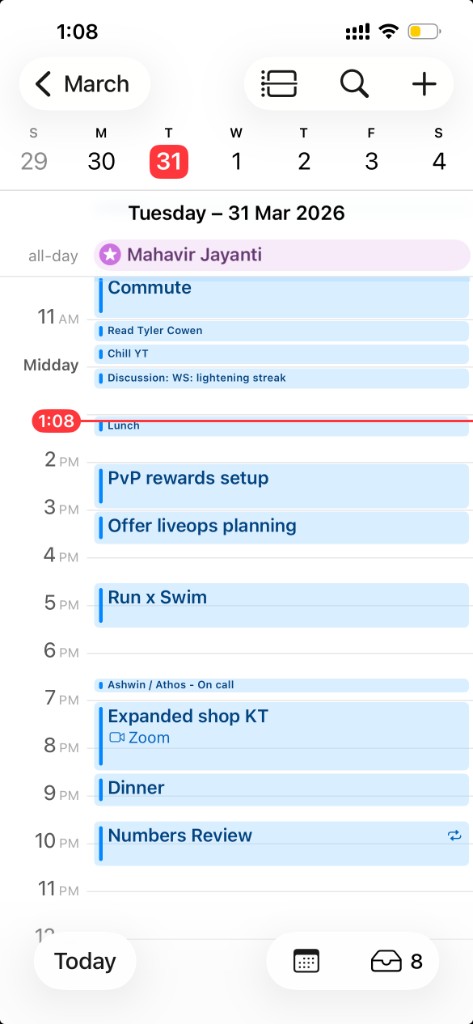
I started it because I felt all over the place in terms of tasks to be done and wanted to be in control. It was more of a productivity spike. It was peace.
Every time you figure out what to do next, there’s a cost. Not just the time — the tiny draw on attention, the small negotiation with yourself, the anxiety of an open loop. Multiplied across a day, that cost becomes the vague exhaustion you feel by 4pm even when you haven’t done much.
Planning the night before collapses it into a single moment, made when the stakes feel low and tomorrow is still abstract enough to think about clearly. You pay the marginal cost of deciding once, from a place of calm.
What I didn’t expect was the closure.
Writing tomorrow down is also the act of saying: today is done. Tasks stop sitting in some background process, half-open, drawing on attention you don’t notice spending. The Zeigarnik effect — we remember incomplete things more readily than complete ones — quietly stops taxing you.
The next day feels lighter. Not because there’s less to do. Because there’s less of today bleeding into it.
Definitely there will be situations where things come up suddenly and you have to move things — but now you have a clear view of what the day looks like and can make a much more informed decision.
The day is complete even before it started.